

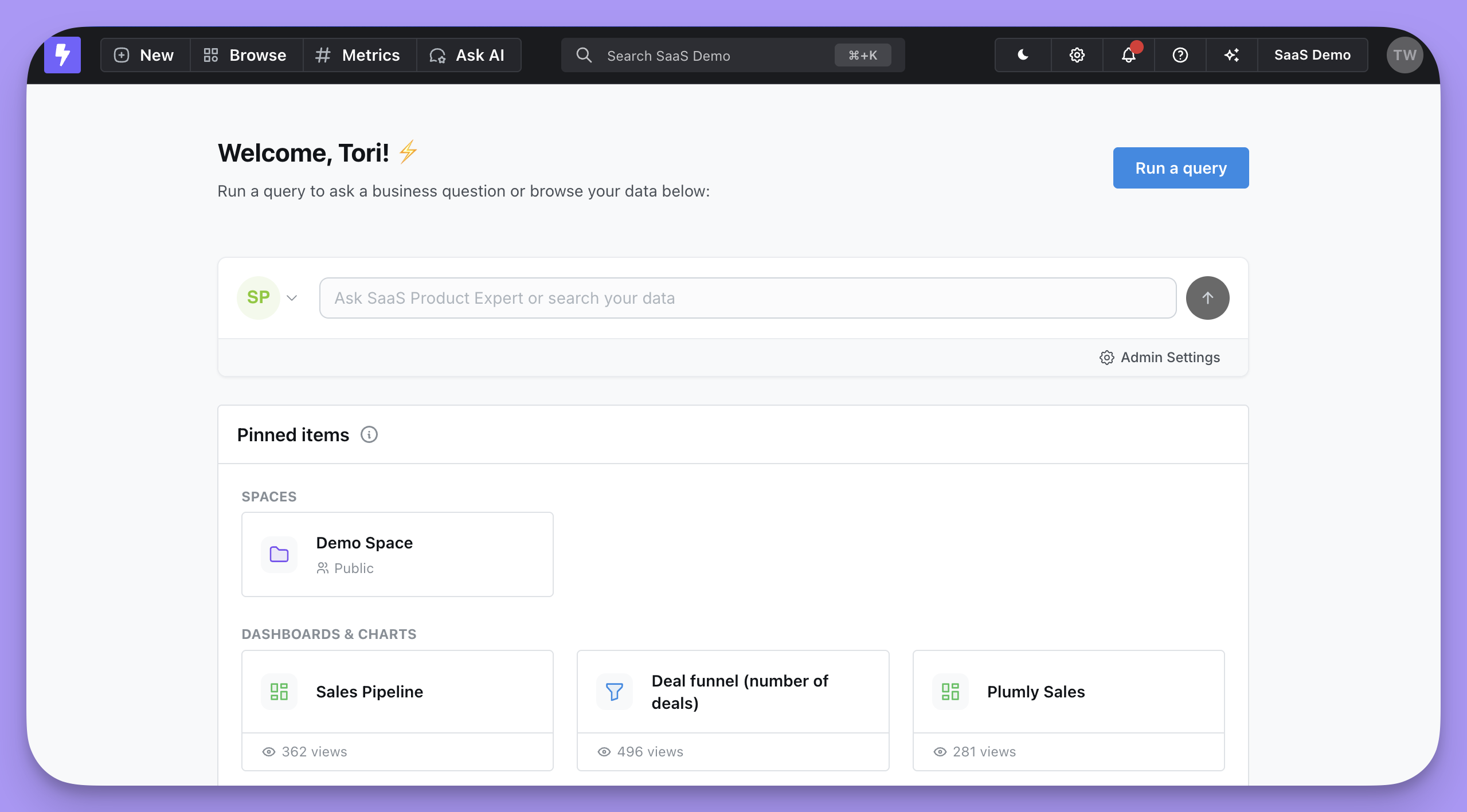
Browse or you can click on the Lightdash icon and select your Space from the homepage.
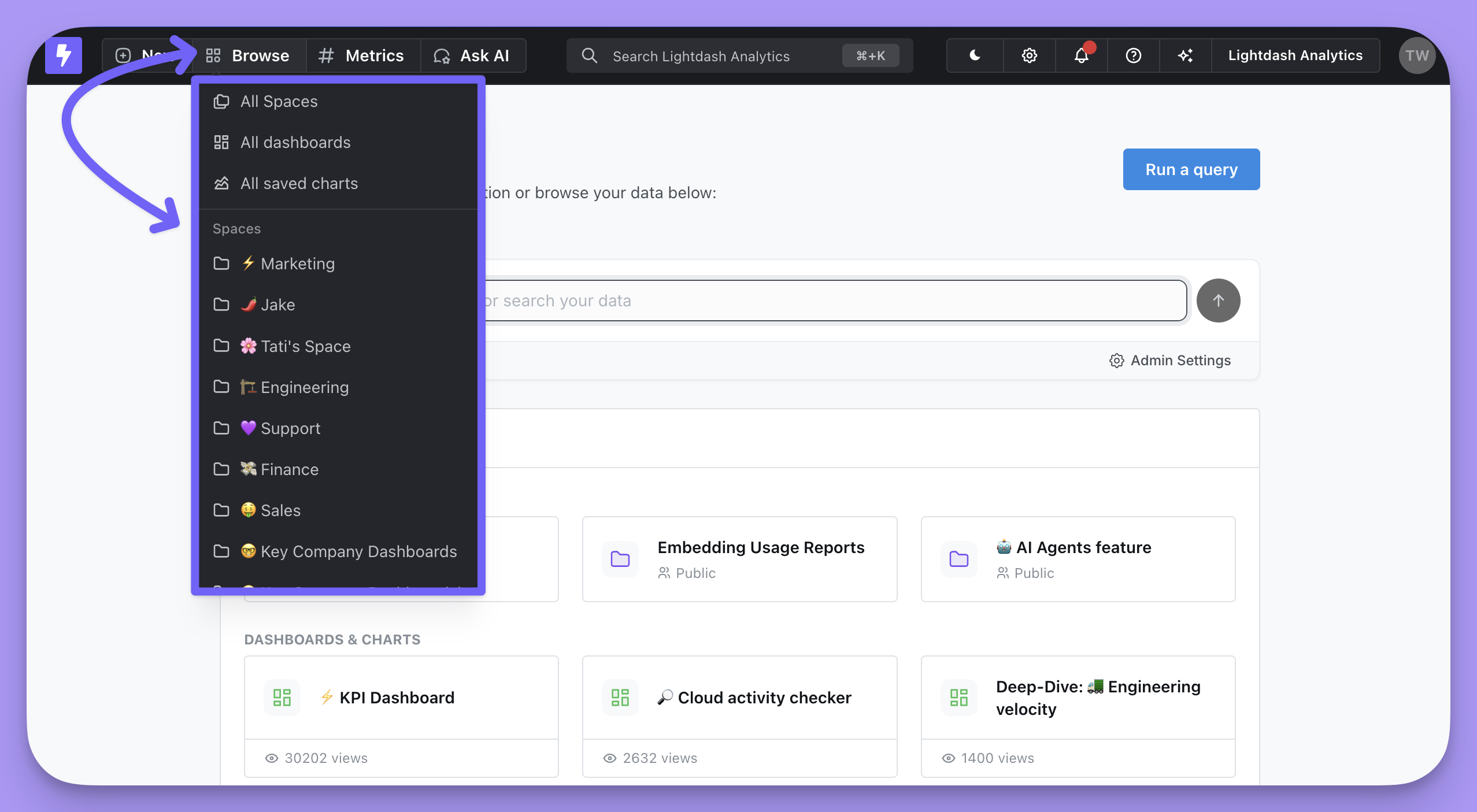
Moving items between Spaces
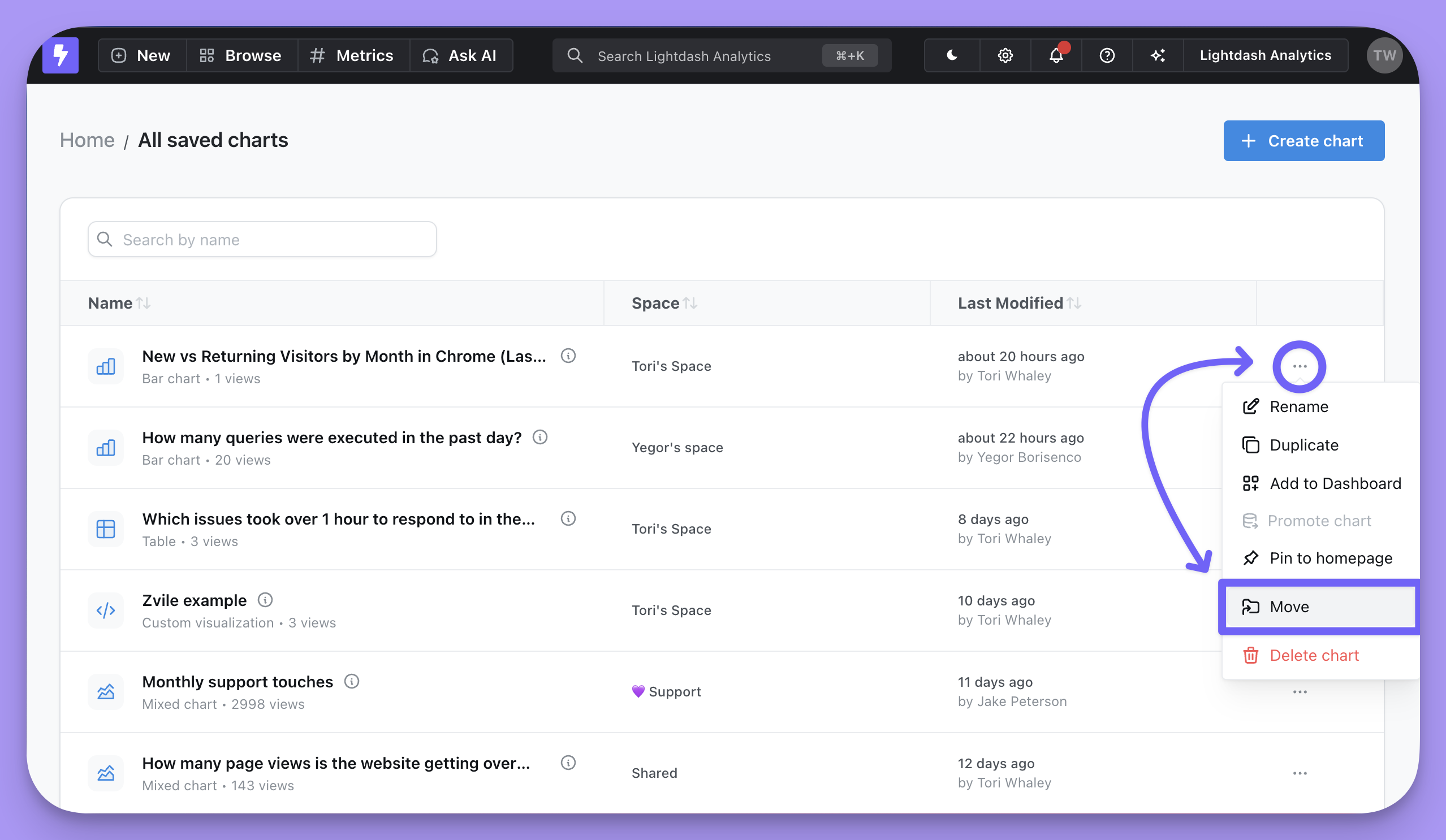
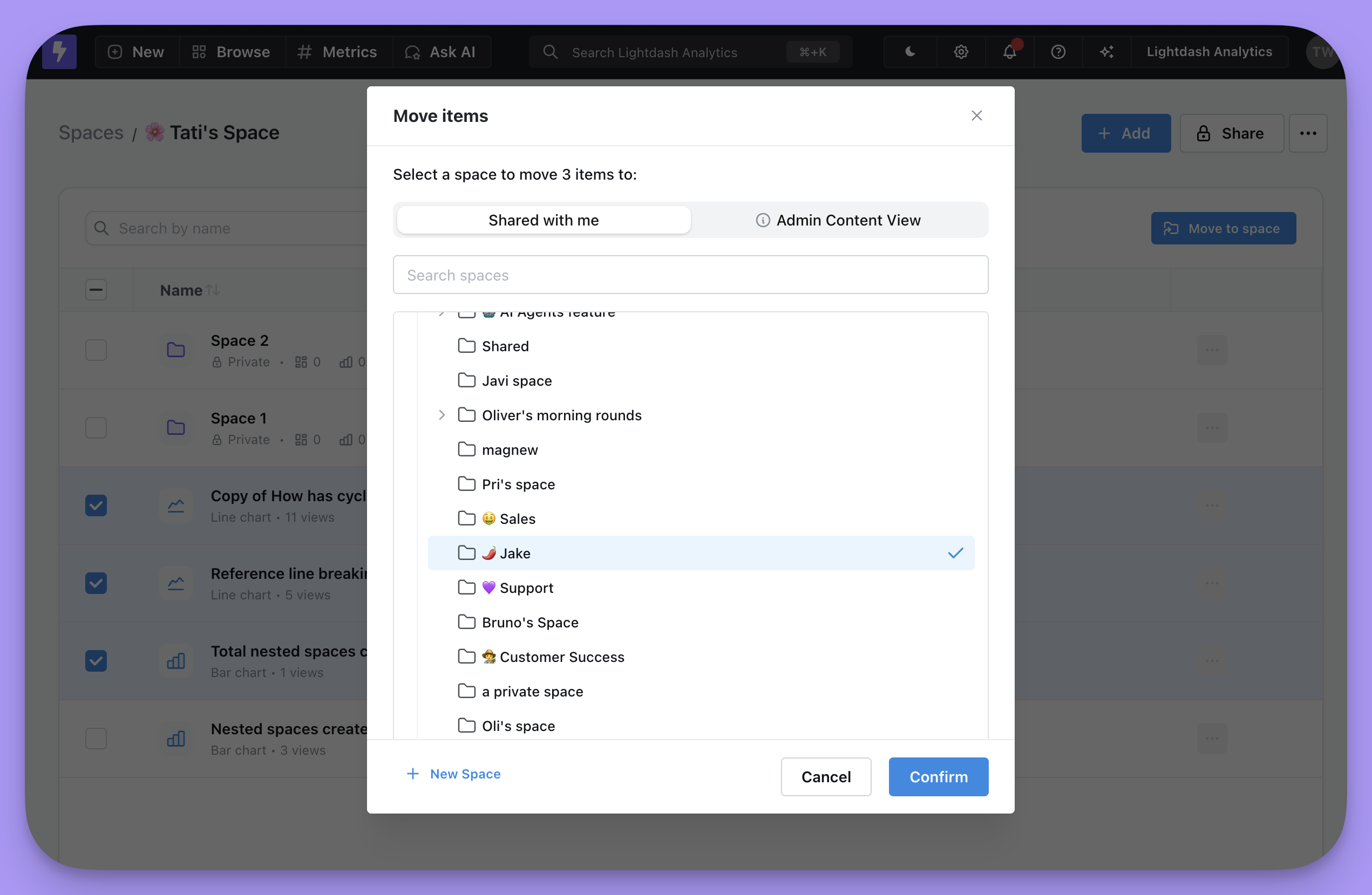
To move a saved chart, dashboard or space between Spaces, you can click on the three dot menu (...) to the right of the item and pick the Move action. Or select items using checkboxes on the left and click Move to Space.
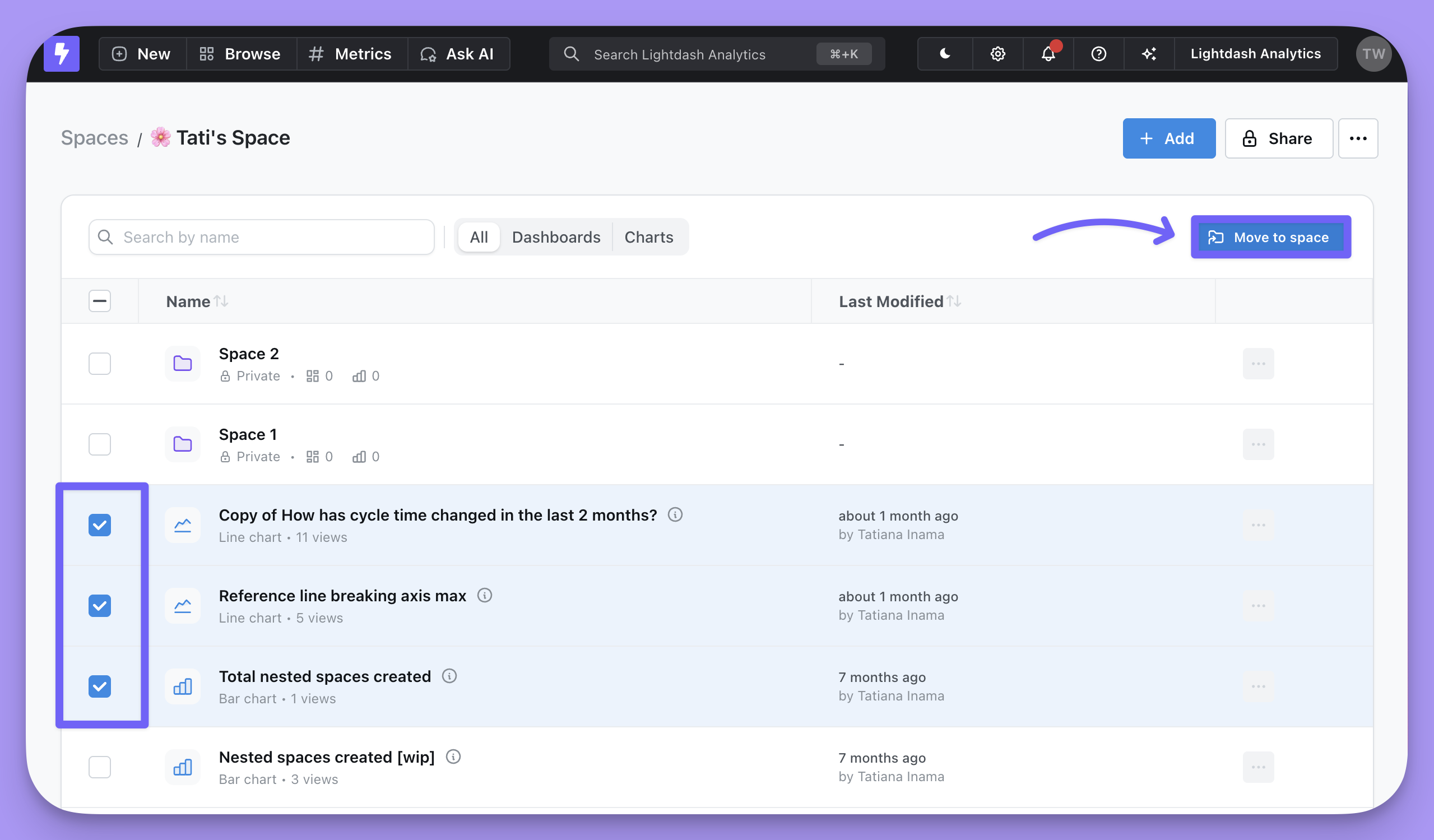
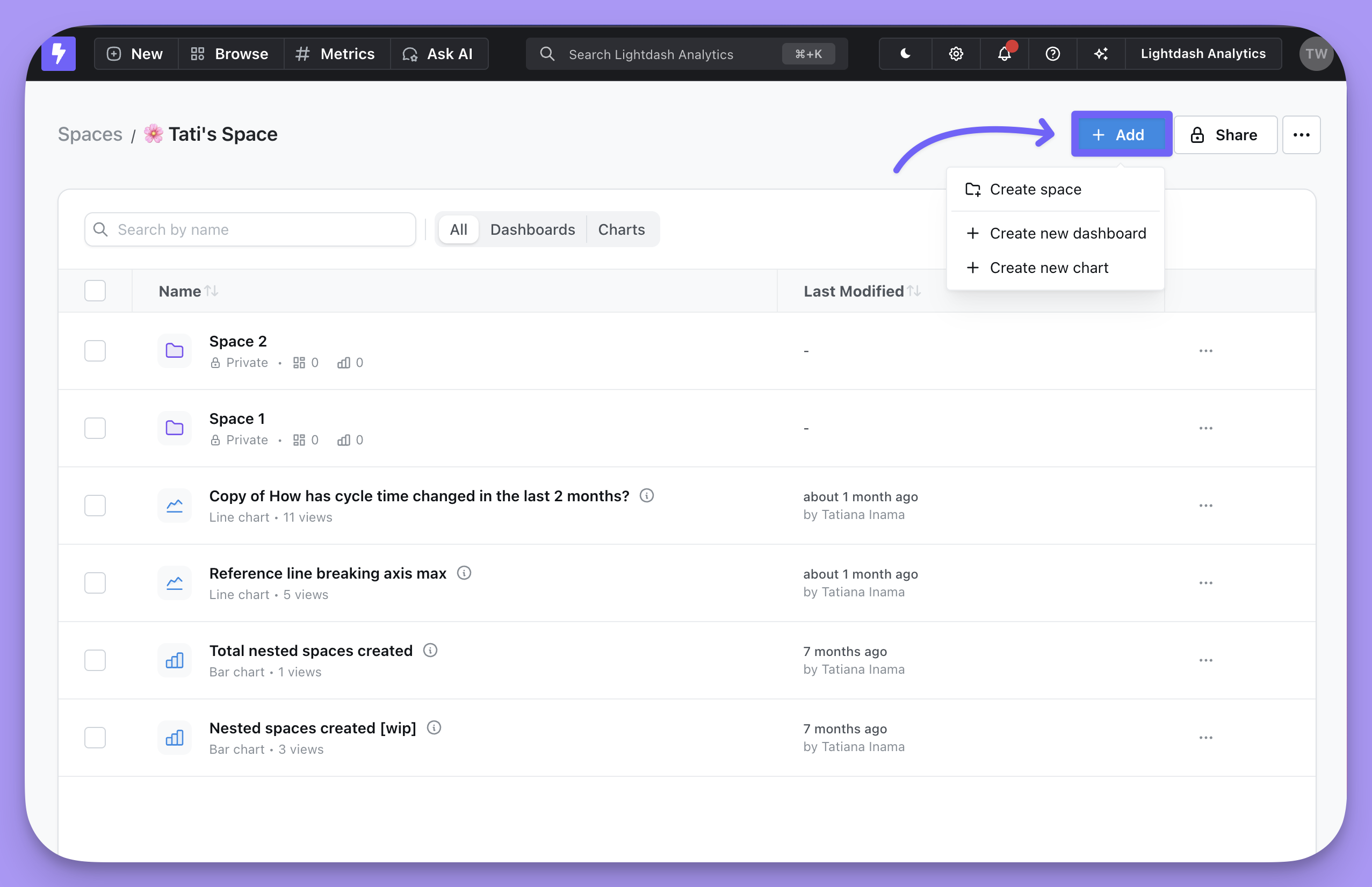
Add button on the space page.
Updating and deleting Spaces
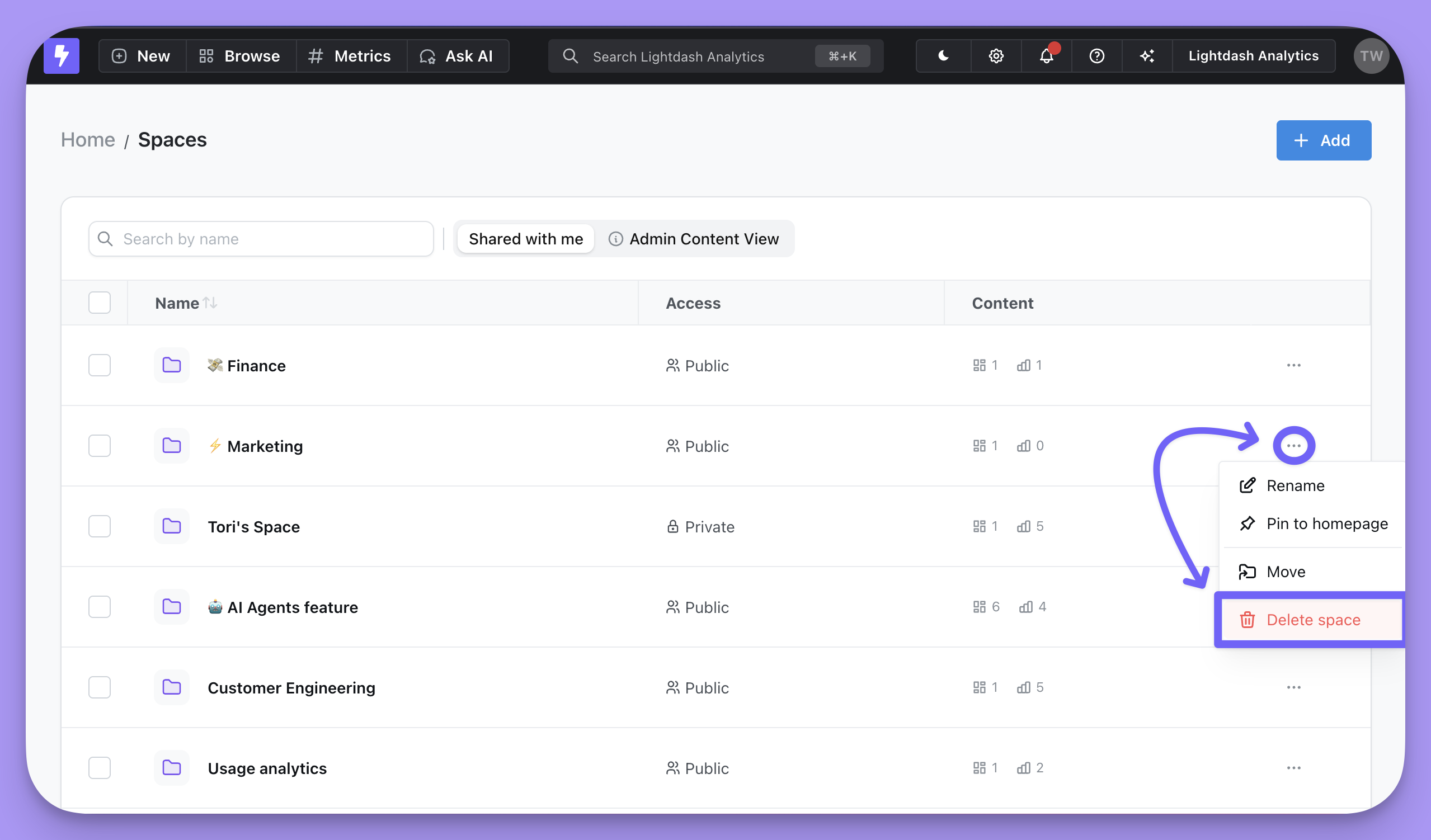
You can rename or delete your Space from All Spaces view or on the homescreen by clicking on the three-dot menu (...) for the Space.
Managing access to a Space
By default, when you create a Space, it has Inherited Access—inheriting permissions from the project (for root-level spaces) or from the parent space (for nested spaces). You can change a space to Restricted Access to limit it to only invited users and admins.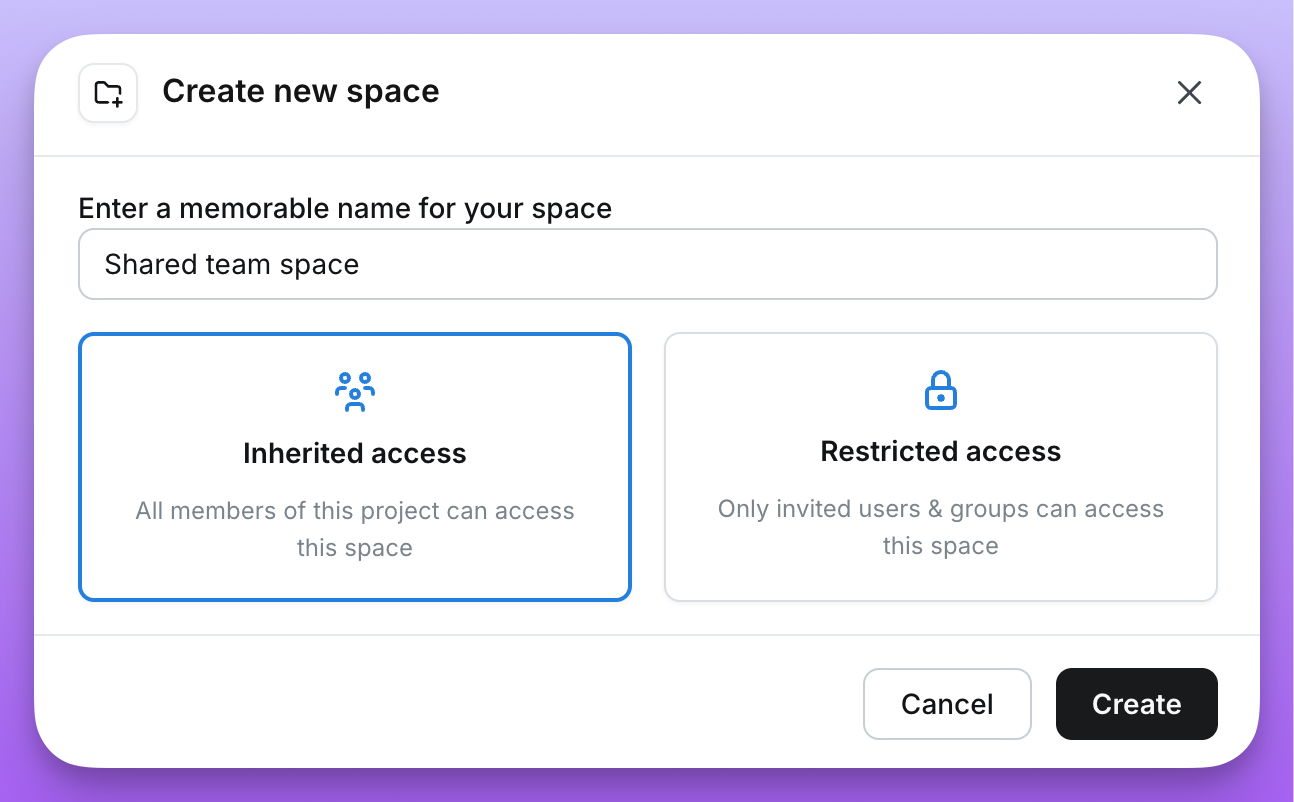
...) and select Share. From there, you can choose between Inherited Access and Restricted Access.
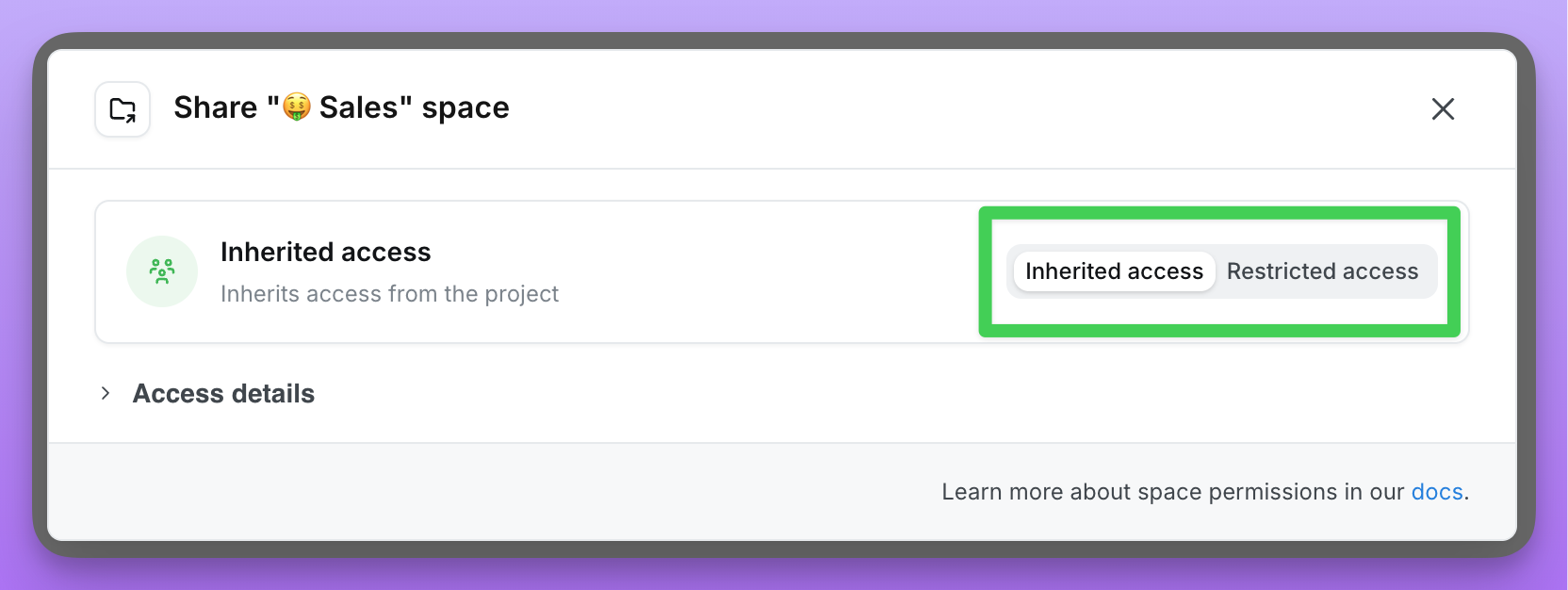
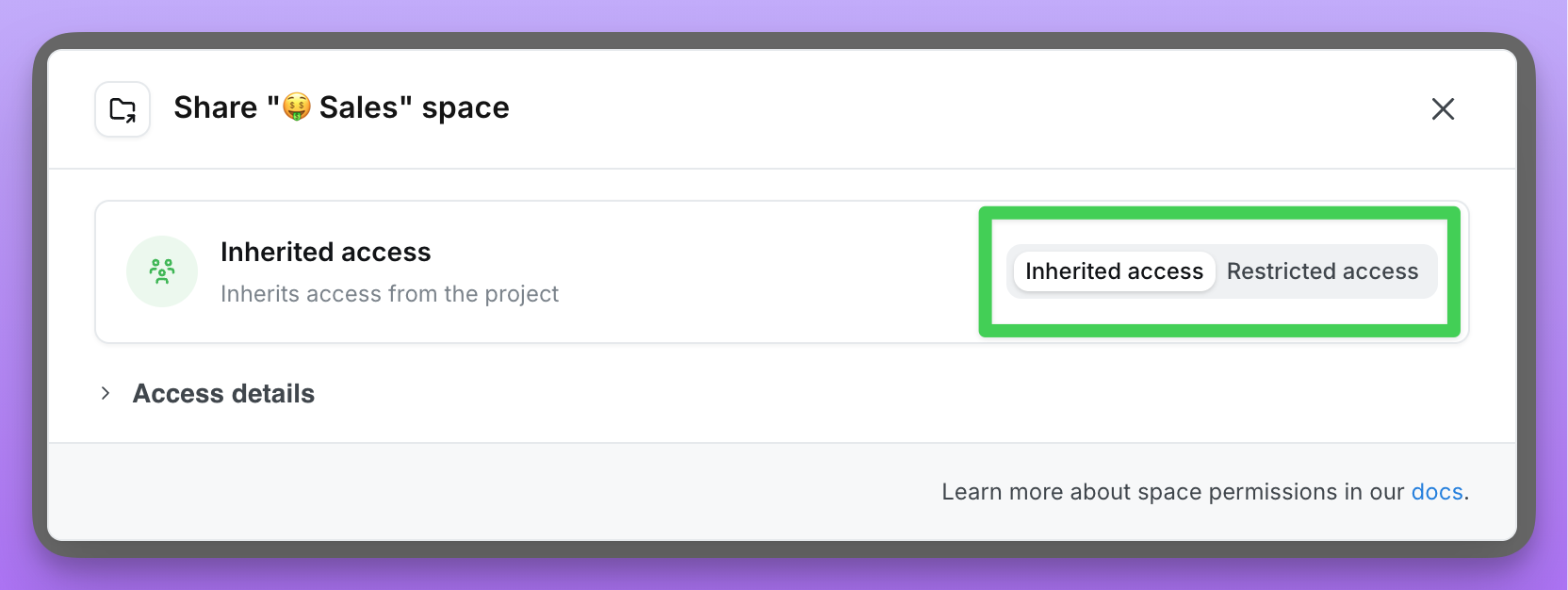
Can View access to a Space.
There are three space roles: Full Access, Can Edit, Can View
For more details about actions you can take in a Space based on your role, check out this table.
Restricted Access spaces
Only admins and members that are invited to a Space with Restricted Access have access to it. For example, here I have a Space with Restricted Access. Only admins and the invited members have access to this Space. Katie, Filipe and Marshall have inheritedFull Access because they are organization admins. Priyanka was invited to the space, so she has Can View access to the space. No one else in Lightdash can see or interact with the content in this Space unless they’re invited or become an admin.
Only users with Full Access permissions to a Restricted Access space can invite other users to that Space.
Nested spaces inherit access from Restricted Access spaces by default. When you create a space inside a Restricted Access space, the nested space automatically uses Inherited Access, meaning it inherits the same restricted permissions from its parent. This makes it easy to organize content within a restricted area while maintaining consistent access control.
Inherited Access spaces
Everyone who has access to your project (or parent space) has access to a space with Inherited Access. For example, here I have a Space with Inherited Access. Everyone who has access to my Project, “Lightdash analytics”, will get access to the content in my space.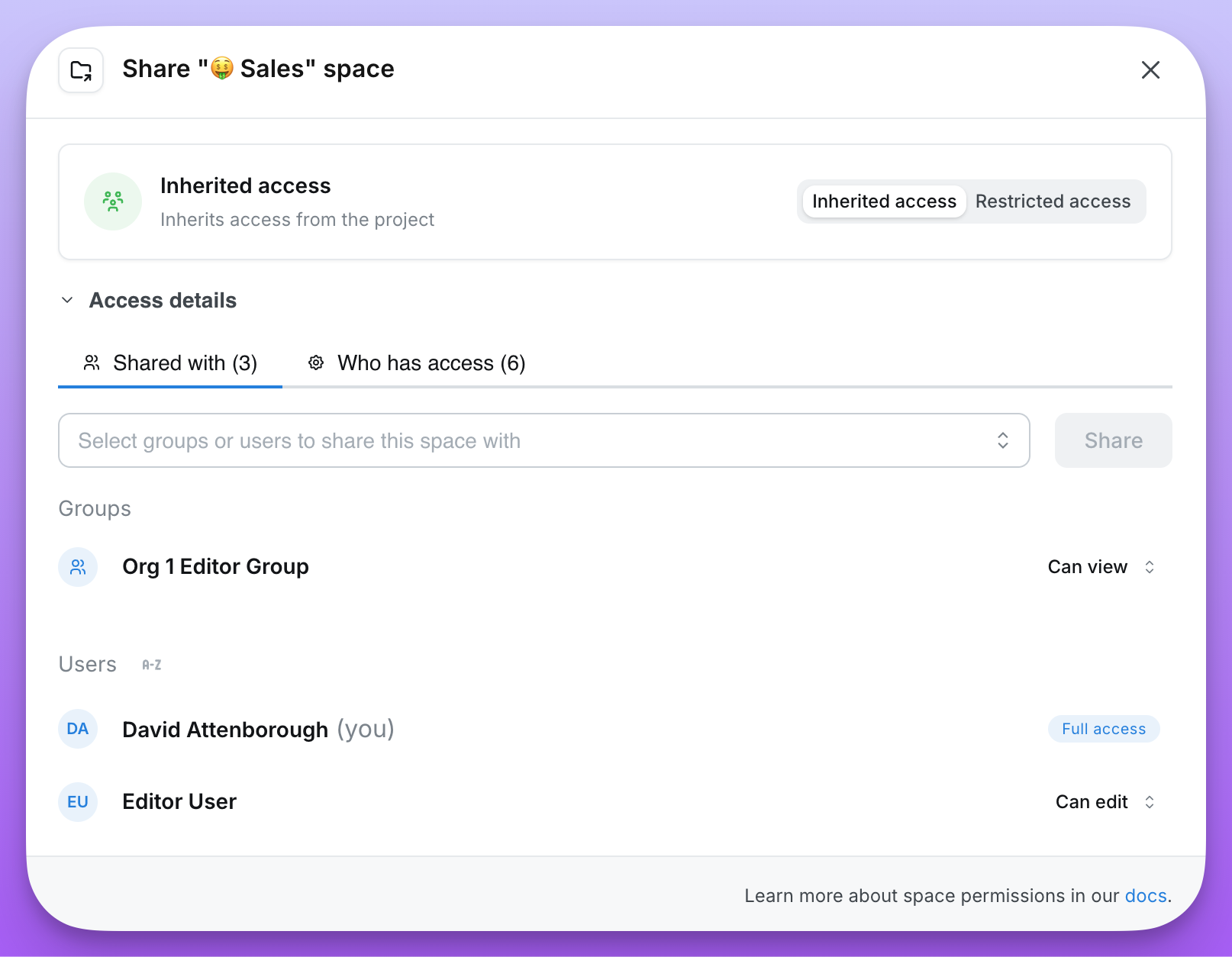
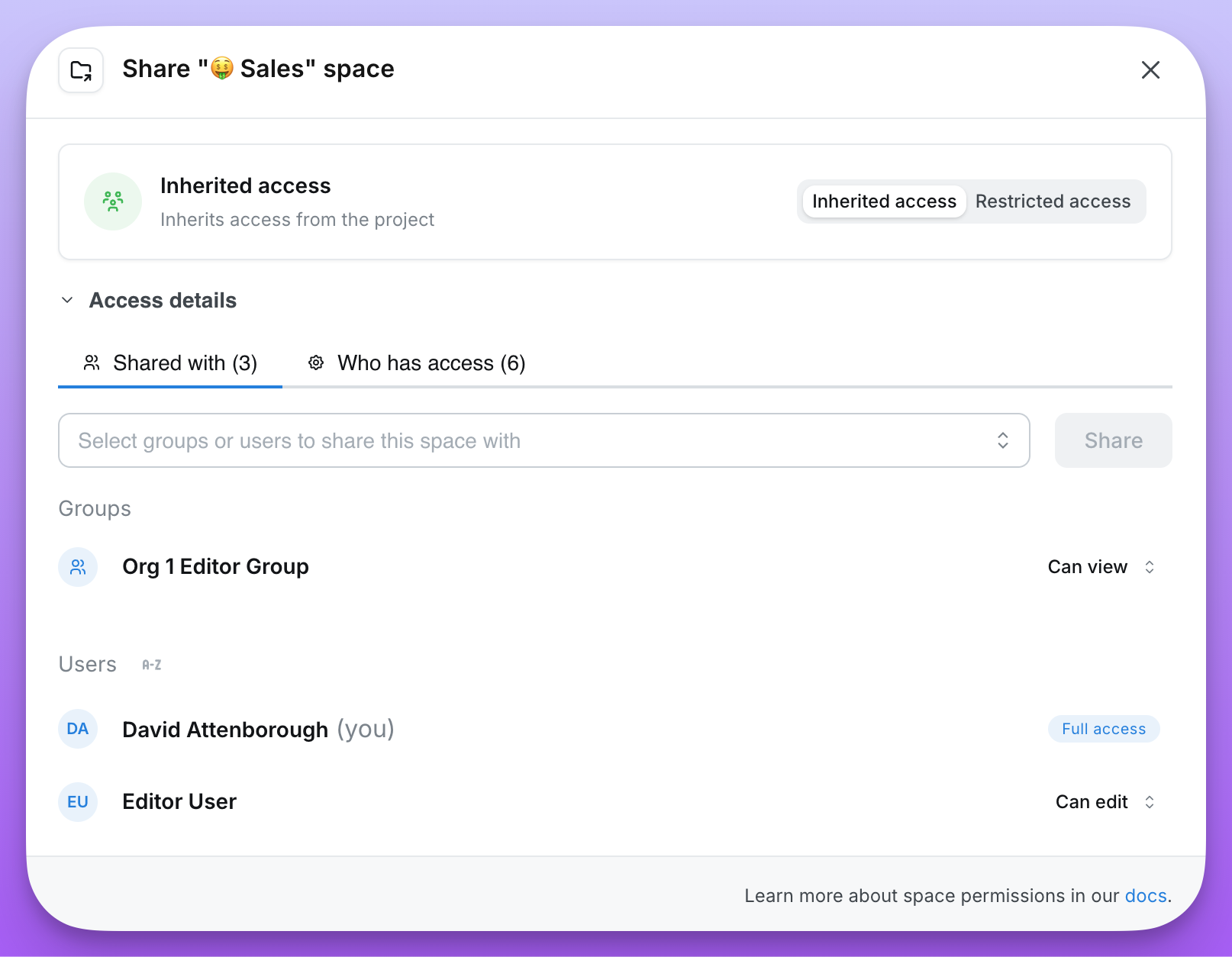
editor in my project, they will have Can Edit permissions in my Space. If someone is a viewer in my project, they will have Can View permissions in my Space. For more details about actions you can take in a Space based on your role, check out this table.
Users with Full Access to the space can change a user’s space permissions.
In Inherited Access spaces (just like in Restricted Access spaces), users who have Full Access to the space can change other users’ space permissions (except admins). Users cannot be removed from Inherited Access spaces. To make a user have no access to a space, you must change the space from Inherited Access to Restricted Access.
Nested space permissions
Spaces can be nested inside other spaces to create a hierarchy. Nested spaces have flexible permission options that allow you to either inherit permissions from their parent or define custom access.Permission inheritance options
When creating or editing a space, you can choose between two access modes:- Inherited Access: The space inherits permissions from its parent. For nested spaces, this means inheriting from the parent space. For root-level spaces, this means inheriting from the project. This is the more open option—users with access to the parent automatically have the same access to the space.
- Restricted Access: The space defines its own permissions, which its children inherit. Only users and groups explicitly invited to this space (plus admins) can access it. This is the more restricted option.
How permission inheritance works
When a nested space uses Inherited Access:- Inheritance chain: Permissions flow down through the space hierarchy. If Space A contains Space B, and Space B contains Space C, then Space C can inherit permissions all the way from Space A (if both B and C use Inherited Access).
- Breaking inheritance: When you switch a space from Inherited Access to Restricted Access, the current inherited permissions are copied as direct access entries. This ensures users don’t suddenly lose access when you restrict permissions.
- Access sources: In the share modal, you can see where each user’s access comes from:
- Direct access: Explicitly granted to this space
- Parent space: Inherited from a parent space
- Project: Inherited from project-level permissions
- Organization: Inherited from organization-level permissions
Managing nested space permissions
To change a nested space’s permission mode:- Navigate into the space
- Click the three-dot menu (
...) and selectShare - Toggle between Inherited Access and Restricted Access
- If switching to Restricted Access, you can then add or remove specific users and groups
When you switch a space to Restricted Access, you automatically receive Full Access to prevent accidentally locking yourself out.
Best practices for nested spaces
- Use groups over individual users: When sharing spaces, prefer adding groups rather than individual users. This makes permission management easier as your team grows.
- Plan your hierarchy: Consider how permissions should flow before creating deeply nested structures.
- Use Inherited Access when possible: Inheriting permissions simplifies management and ensures consistent access across related content.